

Code Europe 2026 in numbers
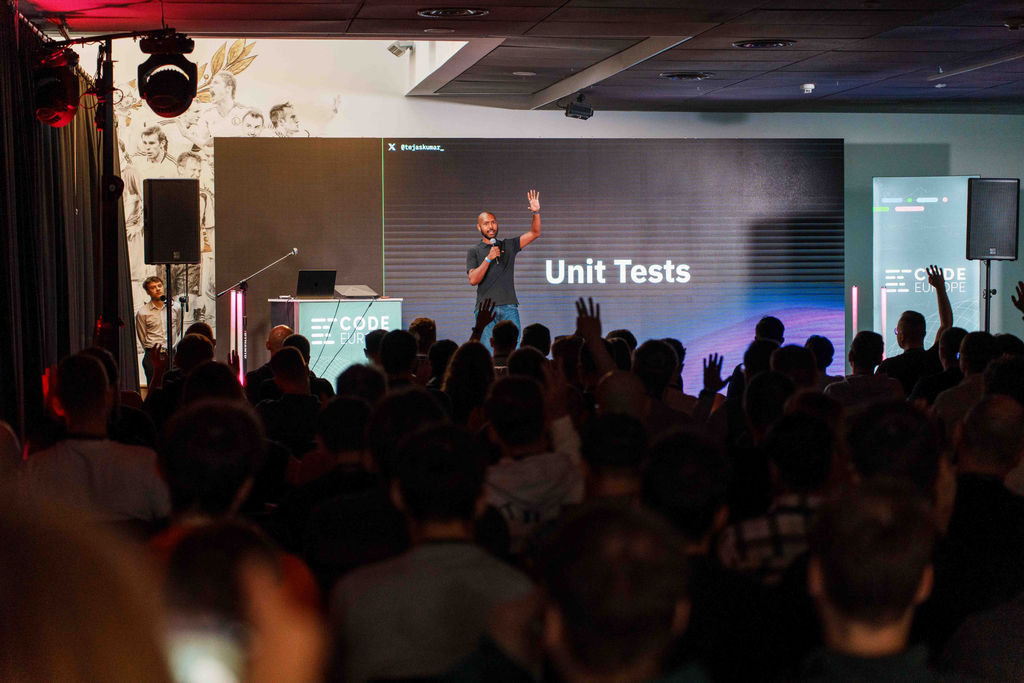
Code Europe 2026 took place on the 14th of September online across CEE and on the 15th of September at Stadion Legii in Warsaw. 1,372 engineers took part across the two days.
We want to show you some data about Code Europe 2026 (all of it is also in the one-page summary if you'd rather have it on a single sheet.)
Who came
678 people came to Warsaw on 15 September. The online day drew 2,338 talk views.
85% of the people who came on-site had also watched online the day before, which we didn't expect. We'd assumed the two days would pull two different audiences. Most on-site attendees treated the online day as part of the same event rather than an alternative to it.
Seniority
72% of attendees were senior or above.
Senior · 36% Staff / Principal · 19% Lead / Manager · 17% Mid · 17% Junior · 11%
Nearly one in five attendees was at staff or principal level. That's the group that's hardest to reach with a conference ticket, because they're the ones with the least free time and the most scepticism about whether a talk will teach them anything.
Tracks
Attendees picked a primary track when they registered.
Software Architecture & Engineering Excellence · 39% AI Engineering & Data · 30% Engineering Careers · 17% Cloud, DevOps & Platform Engineering · 11% Cybersecurity · 4%
Architecture beat AI, which wasn't what we expected going in. Read it alongside the seniority split and it makes sense. People who've been building for a decade are less interested in what a model can do and more interested in what happens to their system when it's wired to one.
Cybersecurity's 4% needs a caveat. We ran security inside the three tracks this year rather than as a track of its own, so it rarely came up as anyone's single primary choice. It isn't a measure of how much the room cared about it.
Tools
We asked what people work with today, and what they want to learn next.
Today they work with JavaScript and TypeScript, Python, Docker, Java, Kubernetes, Node.js, React, C# and .NET.
Next they want to learn Python, which moves up one to first place. Kubernetes climbs two to third. Docker drops two. Go enters the list at eighth with the biggest single jump.
The Docker and Kubernetes swap is the clearest signal in the data. Containers are settled knowledge now, and the thing people want next is running them at scale. Python overtaking JavaScript is the AI work showing up in what engineers plan to learn rather than in what they already do.
From the speakers
Speakers were surveyed after the event, and every respondent said they'd recommend Code Europe to other speakers.
"The travel arrangements were organised extremely well. I attend to many conferences as a speaker and the arrangements were better than most of the other conferences." Petteri Kivimäki · NIIS
"Email correspondence was top notch, plan was clear, no gap in communication, it made my planning process a lot easier." Mourjo Sen · Booking.com
"Everything ran super smoothly, and we could all feel how much you cared about us having a good time and the event being a success." Cristina Poncela Cubeiro · Earendil
"I think yours is already a lot more personal than from most conferences, as there it is usually just an automated e-mail." Christian Schabetsberger
Photos
Shots from the Warsaw day are up in the 2026 gallery, free to download.
What's next
Thanks to everyone who turned up, whether you spoke, ran a stand or just sat in the back row. Recordings from both days stay on the platform until 14 March 2027 for every pass holder.
We're back in April 2027, in Warsaw, with a programme weighted more heavily towards AI engineering. Dates and the call for papers follow shortly.